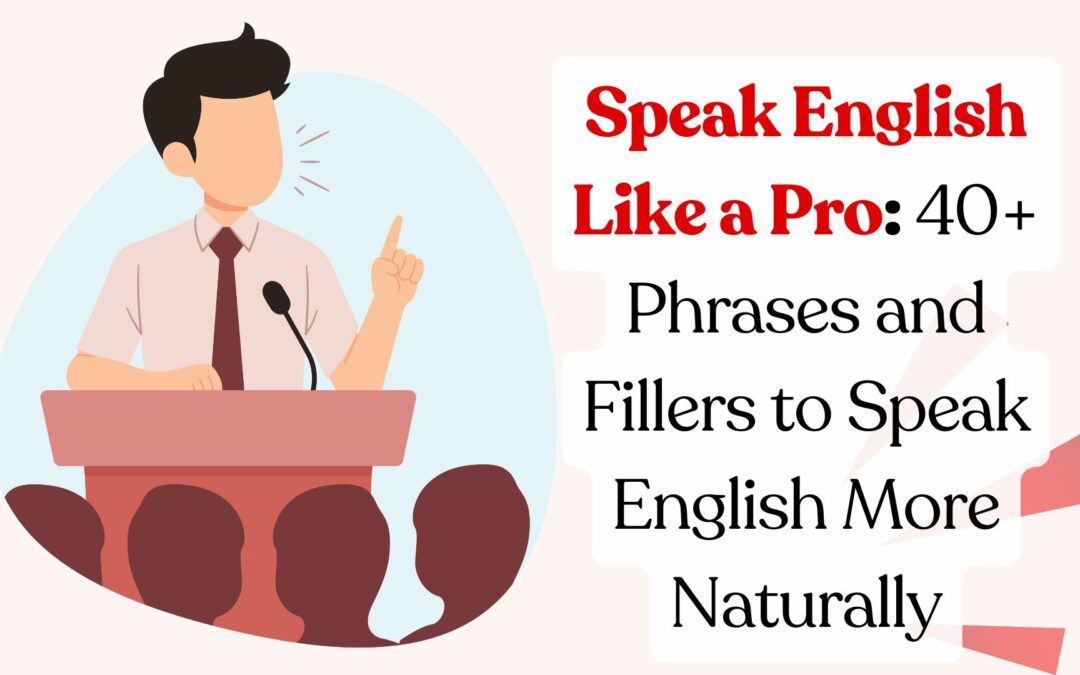
When you’re learning to speak English, it’s easy to focus only on grammar and vocabulary. But if you want to speak English like a native and speak English with confidence in real conversations, you also need something else: phrases and fillers that help you speak English naturally.
“These small expressions are powerful tools for anyone who wants to speak English better. They can help you: start to speak English without long pauses, keep speaking English smoothly and engagingly, and buy time to think while you speak English without sounding unsure.
In this guide, you’ll discover over 40 practical Fluency Boost phrases you can start using right away to speak English more fluently, with clear examples for each.”
40+ Phrases and Fillers to Speak English More Naturally
- Starting Your Response
- Showing You’re Thinking
- Adding More Information
- Showing Agreement
- Showing Disagreement Politely
- Filling Pauses Naturally
- Buying Time
- Changing the Topic
- Summarizing Your Point
- Download the free “Fluency Phrases Guide”
1. Starting Your Response
These phrases are perfect when you want to speak English but need a moment to gather your thoughts.
- Well, you know…
- Actually…
- Let me think…
- That’s a good question…
- To be honest…
- Hmm, let me see…
* Well, you know…
Use it when: You want to start your answer in a casual way, or you need a second to think before continuing.
Example:
- Well, you know, I’ve always enjoyed cooking, even as a kid.
- Well, you know, we could try a different approach next time.
* Actually…
Use it when: You want to correct something, add surprising information, or express your true opinion.
Example:
- Actually, I’ve never been to New York, but I’d love to go.
- Actually, the meeting was moved to Thursday, not Friday.
* Let me think…
Use it when: You need a short pause to organize your thoughts before answering.
Example:
- Let me think… I guess the best way to get there is by train.
- Let me think… Oh yes, we met in 2018 at that conference.
* That’s a good question…
Use it when: Someone asks something interesting or challenging, and you need a moment to consider your answer.
Example:
- That’s a good question… I’d probably choose Japan for my next trip.
- That’s a good question… I’m not sure we’ve decided yet.
* To be honest…
Use it when: You want to share your genuine feelings or opinions, sometimes about something sensitive.
Example:
- To be honest, I’m not a big fan of spicy food.
- To be honest, I don’t think the plan will work unless we make changes.
* Hmm, let me see…
Use it when: You’re searching your memory or deciding between options.
Example:
- Hmm, let me see… I think we have a meeting at 3:00.
- Hmm, let me see… Oh yes, her name is Julia.
2. Showing You’re Thinking
If you need a second to prepare your next thought, these phrases help you speak English more naturally.
- You see…
- The thing is…
- What I mean is…
- How can I put it…
- If I’m not mistaken…
- Let me put it this way…
* You see…
Use it when: You want to explain something in a way that helps the other person understand your point better.
Example:
- You see, the problem isn’t the design—it’s the timing of the launch.
- You see, I grew up in a small town, so big cities feel overwhelming to me.
* The thing is…
Use it when: You want to highlight the main point or problem in a situation.
Example:
- The thing is, we just don’t have enough data yet to make a decision.
- The thing is, I’m not sure I can make it to the meeting tomorrow.
* What I mean is…
Use it when: You want to clarify or rephrase what you just said to make it clearer.
Example:
- What I mean is, we need to focus more on quality than quantity.
- What I mean is, we should talk to them before making any changes.
* How can I put it…
Use it when: You’re searching for the right words to express something carefully or politely.
Example:
- How can I put it… This project is exciting, but also very risky.
- How can I put it… The food was okay, but not amazing.
* If I’m not mistaken…
Use it when: You’re sharing information you believe is correct, but you’re not 100% certain.
Example:
- If I’m not mistaken, the deadline is next Monday.
- If I’m not mistaken, we’ve already met at last year’s conference.
* Let me put it this way…
Use it when: You want to explain something in a simpler or more relatable way.
Example:
- Let me put it this way: without more funding, the project can’t continue.
- Let me put it this way: it’s like trying to run a car without fuel.
3. Adding More Information
Use these phrases to connect your ideas smoothly and speak English more fluently.
- Also…
- Besides…
- On top of that…
- And another thing is…
- Not only that, but…
- In addition…
* Also…
Use it when: You want to add another point in a simple, direct way.
Example:
- We need to finish the report today. Also, we should double-check the figures.
- She’s an excellent singer. Also, she plays the piano beautifully.
* Besides…
Use it when: You want to add information that strengthens your argument or point of view.
Example:
- I don’t feel like going out tonight. Besides, it’s raining.
- We shouldn’t cancel the event. Besides, most people have already booked tickets.
* On top of that…
Use it when: You want to emphasize extra reasons, especially if they make a situation more extreme.
Example:
- The traffic was terrible. On top of that, it started pouring rain.
- She’s an amazing leader. On top of that, she’s always willing to help her team.
* And another thing is…
Use it when: You’re adding a new point in conversation, especially when explaining or complaining.
Example:
- And another thing is, the delivery was two days late.
- And another thing is, they never replied to my email.
* Not only that, but…
Use it when: You want to make your point stronger by adding another surprising or important fact.
Example:
- Not only that, but he offered to help for free.
- Not only that, but they also gave us a full refund.
* In addition…
Use it when: You’re adding information in a more formal or structured way, often in presentations or writing.
Example:
- In addition, the new policy will help reduce costs.
- In addition, we should consider expanding to new markets.
4. Showing Agreement
These phrases help you speak English in a way that shows support and keeps the conversation engaging.
- Exactly!
- Absolutely.
- That’s true.
- I couldn’t agree more.
- Right, right…
- Yes, definitely.
* Exactly!
Use it when: You strongly agree with what someone just said, often with enthusiasm.
Example:
- A: I think we should take a break before starting the next task.
B: Exactly! We’ll work better after a short rest. - A: People waste too much time on their phones these days.
B: Exactly!
* Absolutely.
Use it when: You completely agree, often in a confident or emphatic tone.
Example:
- A: We need to focus on quality, not just speed.
B: Absolutely. - A: Good customer service is the key to keeping clients.
B: Absolutely.
* That’s true.
Use it when: You agree in a calm, conversational way.
Example:
- A: The weather’s been much warmer this year.
B: That’s true. - A: It’s important to exercise regularly.
B: That’s true.
* I couldn’t agree more.
Use it when: You want to show very strong agreement—it means “I totally agree.”
Example:
- A: This is the best pizza place in town.
B: I couldn’t agree more. - A: We should invest in better training for the team.
B: I couldn’t agree more.
* Right, right…
Use it when: You agree while processing or thinking about what the other person said.
Example:
- A: If we start earlier, we can finish before lunch.
B: Right, right… That makes sense. - A: The meeting’s moved to Friday.
B: Right, right… Got it.
* Yes, definitely.
Use it when: You want to agree strongly, showing certainty.
Example:
- A: We should celebrate after the project is done.
B: Yes, definitely. - A: Do you think this plan will work?
B: Yes, definitely.
5. Showing Disagreement Politely
Disagreeing can be tricky — these phrases help you speak English politely and respectfully.
- I see your point, but…
- I’m not sure I agree with that.
- That’s one way to see it, but…
- Well, in my opinion…
- I get what you mean, although…
* I see your point, but…
Use it when: You want to show you understand the other person’s view before expressing your different opinion.
Example:
- I see your point, but I think we should wait until we have more data.
- I see your point, but the budget just won’t allow for that right now.
* I’m not sure I agree with that.
Use it when: You want to politely express doubt or disagreement without sounding rude.
Example:
- I’m not sure I agree with that—there are other factors to consider.
- I’m not sure I agree with that. Maybe we should check the facts first.
* That’s one way to see it, but…
Use it when: You acknowledge their perspective, but you have a different interpretation or opinion.
Example:
- That’s one way to see it, but we might also look at the long-term effects.
- That’s one way to see it, but the statistics suggest otherwise.
* Well, in my opinion…
Use it when: You want to present your personal point of view clearly and directly.
Example:
- Well, in my opinion, remote work is more productive for our team.
- Well, in my opinion, the book was better than the movie.
* I get what you mean, although…
Use it when: You want to show understanding while introducing a contrasting idea.
Example:
- I get what you mean, although I think we should also consider customer feedback.
- I get what you mean, although the risk seems higher than you think.
6. Filling Pauses Naturally
Sometimes you need a second to find the right word — these fillers can help in keeping you talking while you think.
- You know…
- I mean…
- Like…
- Sort of…
- Kind of…
- You see…
* You know…
Use it when: You want to check if the listener understands or agrees, or when filling a pause while you think.
Example:
- She’s really talented, you know?
- It was so awkward, you know, when no one knew what to say.
* I mean…
Use it when: You want to clarify, correct yourself, or add more detail.
Example:
- It’s not that I don’t like the idea—I mean, it’s just a bit risky.
- I mean, we could try a different approach next time.
* Like…
Use it when: You’re giving an example, describing something, or thinking while you speak.
Example:
- It was, like, the most delicious cake I’ve ever had.
- He’s, like, always late to meetings.
* Sort of…
Use it when: You want to soften a statement or show that something is partly true.
Example:
- I’m sort of tired, but I can still go out.
- It’s sort of like a puzzle—you have to figure out the right pieces.
* Kind of…
Use it when: Similar to “sort of,” it softens statements or shows something is approximate.
Example:
- It’s kind of cold today, isn’t it?
- She’s kind of shy, but really friendly once you get to know her.
* You see…
Use it when: You want to explain something or make your point clearer (more intentional than the casual filler “you know”).
Example:
- You see, the problem is we don’t have enough staff for the event.
- You see, I grew up in a different culture, so my perspective is a bit different.
How to Learn English by Yourself? Learn more…
7. Buying Time
Use these phrases when you need a moment to think before answering, so you can speak English smoothly and confidently.
- Let me think for a second…
- That’s an interesting point…
- Well, how can I say this…
- Hmm, where should I start…
- Give me a moment…
* Let me think for a second…
Use it when: You need a short pause to remember something or consider your answer.
Example:
- Let me think for a second… Oh yes, we last met in 2019.
- Let me think for a second… I believe the nearest gas station is about five minutes away.
* That’s an interesting point…
Use it when: You want to acknowledge someone’s idea before responding, often to give yourself time to think.
Example:
- That’s an interesting point… I hadn’t considered the budget impact before.
- That’s an interesting point… Let’s explore that idea further.
* Well, how can I say this…
Use it when: You’re about to explain something carefully or give delicate feedback.
Example:
- Well, how can I say this… the design looks good, but it’s not quite what we agreed on.
- Well, how can I say this… your answer is close, but not exactly correct.
* Hmm, where should I start…
Use it when: You have a lot to say and need a moment to decide your starting point.
Example:
- Hmm, where should I start… there were so many things that went wrong at the event.
- Hmm, where should I start… first, the hotel was overbooked.
* Give me a moment…
Use it when: You want a brief pause before continuing, often to collect your thoughts or check something.
Example:
- Give me a moment… I just need to find the document.
- Give me a moment… Okay, here’s the answer to your question.
8. Changing the Topic
When it’s time to move to something else, try:
- Anyway…
- By the way…
- Speaking of which…
- That reminds me…
- On another note…
* Anyway…
Use it when: You want to return to your main topic after a small digression, or signal a change in topic.
Example:
- Anyway, as I was saying, we’ll need to submit the report by Friday.
- Anyway, let’s get back to the main point.
* By the way…
Use it when: You want to add extra, often unrelated, information in a casual way.
Example:
- By the way, did you hear about the new coffee shop downtown?
- By the way, your presentation yesterday was fantastic.
* Speaking of which…
Use it when: Something reminds you of a related topic or detail.
Example:
- I saw John yesterday—speaking of which, how’s his project going?
- The movie was great—speaking of which, have you seen the trailer for the sequel?
* That reminds me…
Use it when: Something someone said triggers a memory or related thought.
Example:
- That reminds me, I still need to send you those files.
- That reminds me, we should check the schedule for next week.
* On another note…
Use it when: You want to introduce a new, often unrelated, topic in a smoother or more formal way.
Example:
- On another note, the marketing team will have a meeting tomorrow.
- On another note, congratulations on your promotion!
9. Summarizing Your Point
To finish and wrap up your idea when you speak English, say:
- So, what I’m saying is…
- In short…
- Basically…
- To sum up…
- All in all…
* So, what I’m saying is…
Use it when: You want to restate your main point to make sure the listener understands.
Example:
- So, what I’m saying is, we need to focus on quality, not just speed.
- So, what I’m saying is, this change will benefit everyone in the long run.
* In short…
Use it when: You want to give a quick, simple summary of a longer explanation.
Example:
- In short, the event was a success despite the bad weather.
- In short, we need more time and more resources.
* Basically…
Use it when: You want to simplify your explanation or give the essence of an idea.
Example:
- Basically, the plan is to expand into three new markets next year.
- Basically, he’s asking for a second chance.
* To sum up…
Use it when: Use this to wrap up your points in a structured way when you speak English in formal or semi-formal situations.
Example:
- To sum up, we’ve improved our sales, expanded our team, and launched two new products.
- To sum up, the advantages outweigh the disadvantages.
* All in all…
Use it when: Use this to give your final opinion when you speak English after considering everything.
Example:
- All in all, it was a great trip.
- All in all, I think we made the right decision.
How to Practice These Phrases While You Speak English
- Pick 3–4 phrases and use them in your conversations this week.
- Listen to English speakers in movies or podcasts and notice how they use them.
- Record yourself speaking English with these phrases to build confidence and improve your fluency.
The more you use them, the more natural they’ll become — and soon, you won’t even have to think about it.
Visit our YouTube channel and explore engaging lessons designed to expand your vocabulary across a wide range of topics, helping you speak English with greater confidence and fluency in everyday conversations.
Which of these Fluency Boost phrases will you try first when you speak English next time? Share your answer in the comments below and let’s practice together!
Download the free “Fluency Phrases Guide”